
Basement Structural Drying & Dehumidification
Removing moisture left inside drywall, framing, subfloor and concrete after extraction, verified with readings.
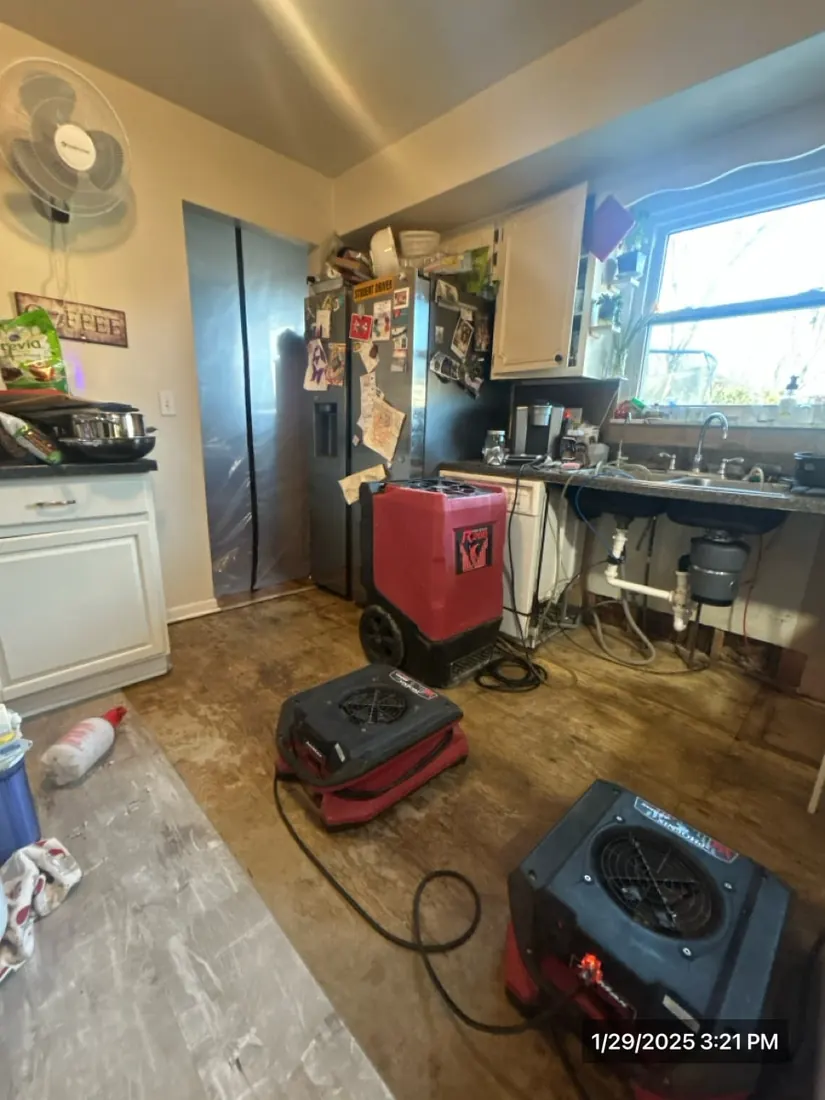
Structural drying and dehumidification is the stage that removes moisture left inside building materials after the standing water is gone. Extraction takes out liquid water; drying addresses the water that soaked into drywall, framing, subfloor and concrete. Homeowners often ask whether fans alone are enough, usually they are not, because air movement and dehumidification do two different jobs.
Structural Drying & Dehumidification at a glance
- Baseline moisture readings
- Place air movers and dehumidifiers
- Monitor daily
- Compare to a dry standard
- Verify and document completion
Why removing the water isn't the same as drying
After a basement floods, materials act like sponges. Drywall, wood framing, carpet pad and even concrete hold water that no pump can reach. If that moisture is left, it feeds mold and warps materials, which is why the EPA emphasizes drying affected areas within 24 to 48 hours where possible.
A dry-looking surface is not proof the material underneath is dry. This is the single most common misunderstanding in basement flood recovery, and it is why drying is verified with meters rather than assumed from appearance.
How air movers and dehumidifiers work together
The two main tools do opposite halves of the same job. Air movers push air across wet surfaces to speed evaporation, moving moisture from the material into the air. Dehumidifiers then pull that moisture back out of the air so it does not simply re-deposit elsewhere in the basement.
Run air movers without dehumidification and you raise humidity and risk secondary damage. Run a dehumidifier without air movement and surfaces give up moisture slowly. Used together, and sized to the space, they bring materials down to a target.
How drying is measured and verified
Drying is tracked, not guessed. A technician records moisture readings in affected materials and monitors them over days, comparing wet areas against a dry standard elsewhere in the structure. Progress is logged until materials reach an appropriate goal.
This is where moisture detection and drying overlap: detection finds and measures the moisture, drying removes it, and readings confirm when the goal is met.
- Moisture meters measure how wet a material is.
- A dry standard (an unaffected area) sets the target reading.
- Daily readings show whether the drying plan is working or needs adjustment.
- Documentation of readings is what demonstrates the work is complete.
When drying alone can't save a material
Some materials are too damaged or too contaminated to dry in place. Saturated fiberglass insulation, drywall that wicked contaminated water, and some flooring assemblies are removed rather than dried, which is covered under water-damaged material removal and flooring and subfloor restoration.
If a homeowner is weighing equipment rental against professional drying, the real question is verification: rented fans may dry a surface, but without moisture readings there is no way to confirm the assembly underneath is actually dry.
Air movers and dehumidifiers do opposite halves of the job
Drying needs both. One moves moisture out of the material into the air, the other pulls it out of the air.
| Equipment | What it does | On its own |
|---|---|---|
| Air mover | Pushes air across wet surfaces to speed evaporation | Raises humidity; moisture lingers and can redeposit |
| Dehumidifier | Removes moisture from the air | Surfaces give up water slowly without airflow |
| Both together, sized to the space | Evaporate and remove moisture to a target | This is how drying actually reaches completion |
Dealing with this now? Reach a flood cleanup specialist on the 24/7 line at (877) 927-8127, anywhere in the United States.
Safety and technical points on this page follow guidance from the EPA, CDC and the IICRC S500 water damage restoration standard. See editorial and sources.
Related cleanup services
Structural Drying & Dehumidification: frequently asked questions
Are fans enough to dry a flooded basement?
Usually not on their own. Fans (air movers) speed evaporation but push moisture into the air; without a dehumidifier removing that moisture, humidity rises and materials dry slowly or redeposit moisture elsewhere. The two tools are designed to work together.
How long does structural drying take?
It varies with how much water was present, how long materials were wet, the materials themselves and the environment. Many basements take several days of monitored drying. Completion should be based on moisture readings reaching a target, not a fixed number of days.
How do I know the basement is actually dry?
By moisture readings, not appearance. A technician compares affected materials against an unaffected dry standard and documents the readings over time. A dry surface can still sit over a wet subfloor, so verification matters.
What should be in a drying report?
Dated moisture readings for the affected materials, the equipment used and where it was placed, and the drying goal those readings are compared against. That record is how completion is demonstrated.
How many air movers and dehumidifiers does a basement need?
It depends on the square footage, how wet the materials are and the layout, which is why a crew sizes the equipment to the space rather than using a fixed number. The goal is enough airflow and dehumidification to bring materials down to a target reading, confirmed with a meter.
Will a household fan dry a flooded basement?
A box fan moves some air but cannot remove moisture from the air or reach inside materials, so on its own it tends to raise humidity and dry only the surface. Verified structural drying uses air movers paired with dehumidifiers and tracks progress with moisture readings.
Need structural drying & dehumidification help? Reach a specialist on the 24/7 line.
24/7 emergency line · water extraction, drying, sanitization and reconstruction help nationwide