
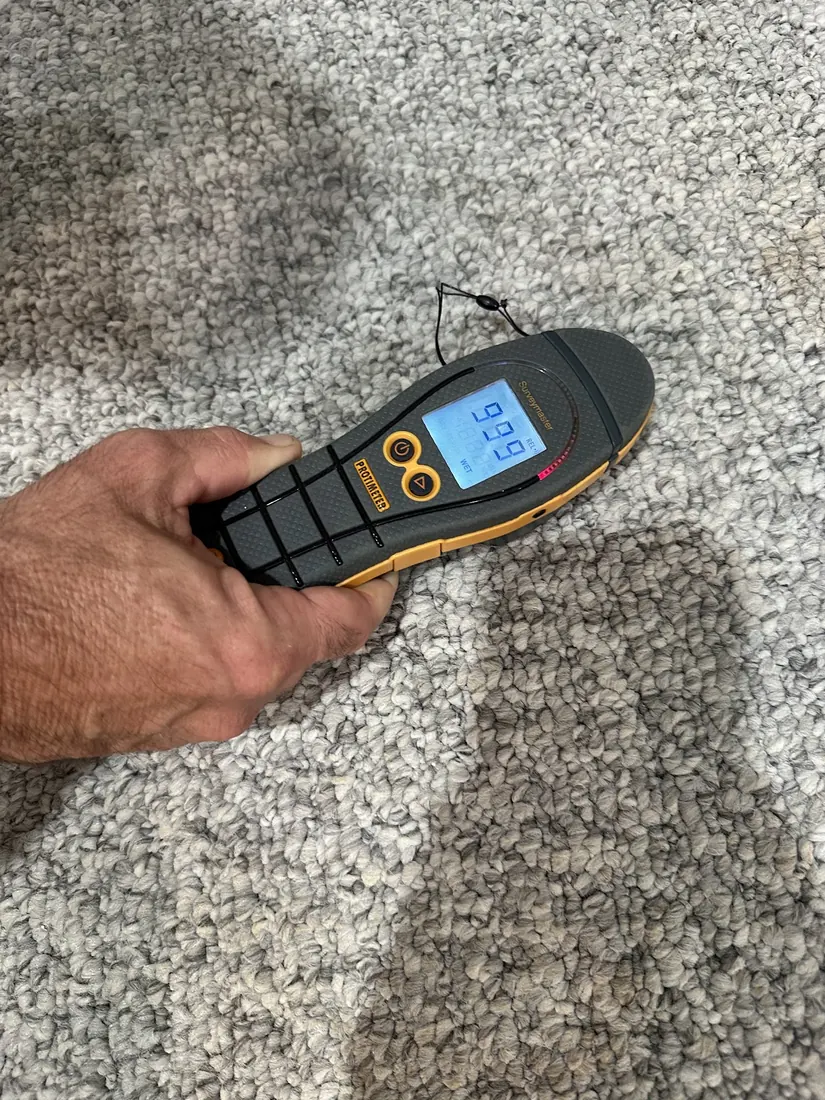
One of the most common, and most missed, problems after a basement flood is water trapped under the flooring. A floor can look and feel completely dry on top while the subfloor beneath it stays soaked. Because water-resistant surfaces like vinyl plank actually trap water underneath, 'the floor looks fine' is not evidence the assembly is dry. Here's how to tell, and what the options are.
How water gets under a 'waterproof' floor
Water-resistant flooring resists water from above, not from the edges and seams. In a flood, water travels around the perimeter of the room, through seams, and up from the slab, then sits between the flooring and the subfloor. The same surface that kept water off the top now keeps trapped water from evaporating.
This is why a sump overflow or a slow leak can leave a floor that feels dry over a subfloor that's holding water, the scenario behind countless 'do I need to pull up my floor?' questions.
How it's detected
You usually can't confirm trapped water by looking. It's found with moisture detection, moisture meters read the subfloor through or around the flooring, and readings are compared to a dry standard elsewhere. A thermal camera can flag a suspicious area, but it shows temperature, not water, so a meter confirms it.
If readings show the subfloor is wet, leaving the floor down seals the moisture in. That's when a section may need to be lifted.
Dry in place, lift, or replace
The decision depends on the flooring and how wet the subfloor is.
- Vinyl plank (LVP): surface often survives, but planks may be lifted to dry the subfloor, then relaid.
- Laminate: usually can't be saved once the core swells and delaminates.
- Tile over concrete: tile may stay, but the slab is checked for retained moisture.
- Subfloor (OSB/plywood): dried if caught early and sound; replaced if swollen or delaminated.
Why this matters so much
New flooring laid over a subfloor that was never actually dry is the classic recurring-problem scenario: odor, warping and mold months later. Confirming the subfloor is dry, with readings, not appearance, before closing it up is the whole point of flooring and subfloor restoration.
Signs water may be trapped under the floor
A dry-looking surface is not proof. These signs point to checking the subfloor with a meter.
| Sign | What it suggests |
|---|---|
| Musty smell with no visible source | Moisture still present under or behind finishes |
| Cupping, lifting or soft spots | Water in the subfloor or planks |
| Water came in around room edges | It likely reached the subfloor through seams |
| A flood that sat for more than a few hours | Time for water to migrate beneath the surface |
A flooded basement doesn't wait. For emergency water extraction, drying or cleanup help, call (877) 927-8127, a 24/7 line, anywhere in the United States.