
Basement Moisture Detection & Inspection
Finding and measuring hidden water behind walls, under floors and in the slab with meters and thermal imaging.
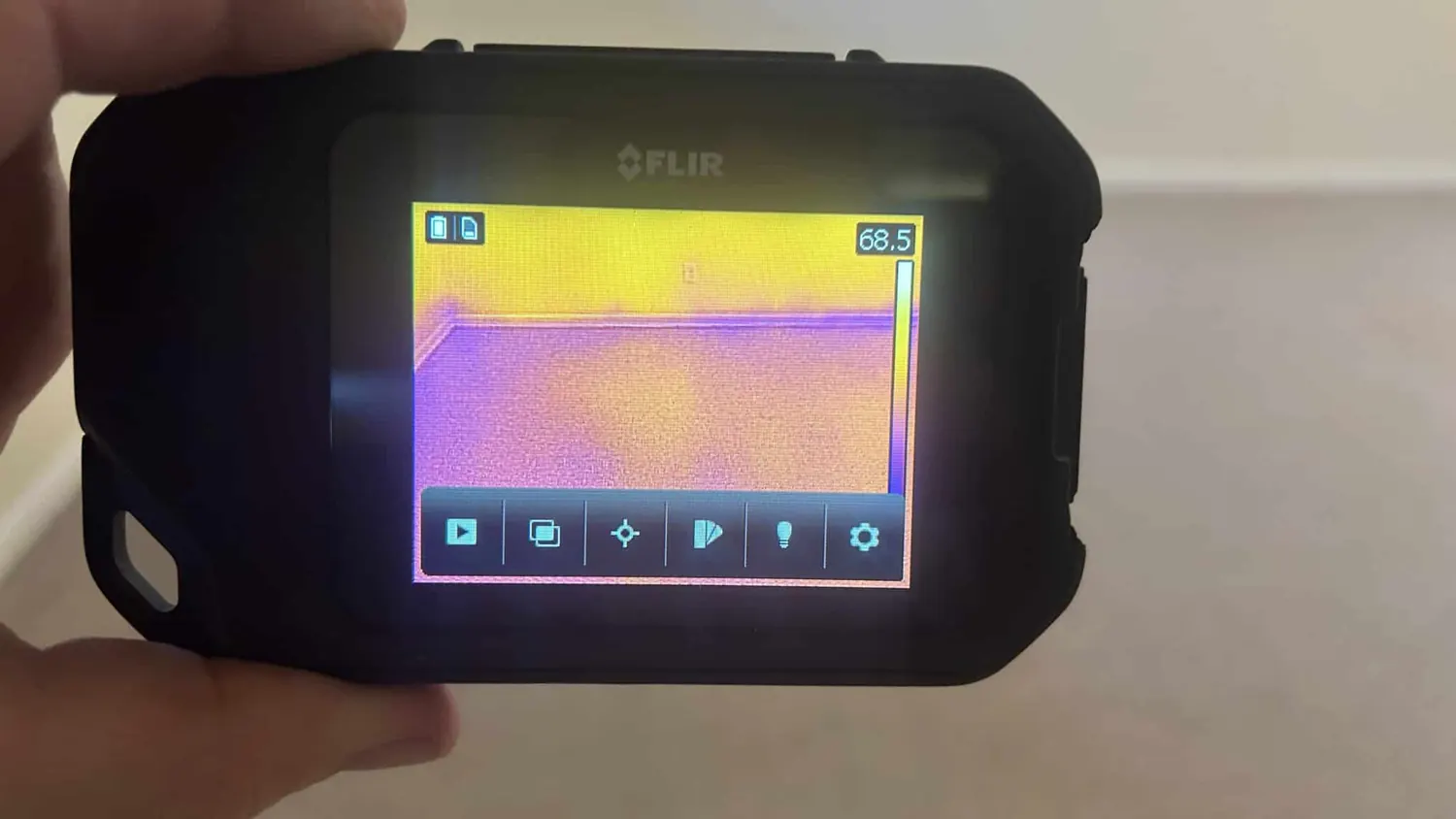
Basement moisture detection is the inspection step that finds and measures water you can't see, behind walls, under flooring and inside the slab, after a flood. It is what tells the rest of the cleanup where to work. Without it, drying is guesswork and hidden moisture turns into mold and odor weeks later.
Basement Moisture Detection at a glance
- Visual assessment
- Thermal imaging scan
- Confirm with moisture meter
- Compare to a dry standard
- Produce a moisture map
Why hidden moisture is the real problem
Water does not stay where it pooled. It wicks up drywall above the visible line, travels under flooring, and soaks into framing and concrete. A floor that feels dry on top can sit over a saturated subfloor. The purpose of moisture detection is to find that concealed water before it causes secondary damage.
This matters most in the cases homeowners worry about: water under vinyl plank or laminate, a sump overflow that spread under walls, and drywall that looks fine but wicked water upward.
Tools and what each one can and can't do
No single tool sees everything, so they are used together and interpreted by someone who knows their limits.
- Moisture meters (pin and pinless) measure how wet a material is at a spot.
- Thermal (infrared) cameras show temperature differences that can indicate moisture, but they detect temperature patterns, not water directly, so readings are confirmed with a meter.
- Hygrometers measure humidity and temperature in the air to guide the drying plan.
- A dry standard, a reading from an unaffected area, gives the numbers meaning.
From a moisture map to a drying plan
The output of detection is a moisture map: where the water went, how wet each area is, and what the drying target should be. That map drives structural drying, tells flooring and subfloor restoration whether a floor can be dried in place, and gives a baseline to verify the job later.
It also answers the question behind many basement odor complaints: a musty smell with no visible cause usually traces back to moisture a meter can find, which is why detection pairs with odor removal.
Detection tools and what each one can and cannot do
No single tool sees everything, so they are used together and read by someone who knows their limits.
| Tool | What it shows | Its limit |
|---|---|---|
| Pin or pinless moisture meter | How wet a material is at a spot | A single-spot reading |
| Thermal (infrared) camera | Temperature patterns that can indicate moisture | Shows temperature, not water; confirmed with a meter |
| Hygrometer | Air humidity and temperature | Guides the drying plan, not material moisture |
| Dry standard | A target reading from an unaffected area | Needed to make the other readings mean anything |
Dealing with this now? Reach a flood cleanup specialist on the 24/7 line at (877) 927-8127, anywhere in the United States.
Safety and technical points on this page follow guidance from the EPA, CDC and the IICRC S500 water damage restoration standard. See editorial and sources.
Related cleanup services
Basement Moisture Detection: frequently asked questions
Can water be trapped under basement flooring even if the surface is dry?
Yes. A water-resistant surface such as vinyl plank does not prove the underlayment or subfloor beneath it is dry. Water migrates through seams and around edges, so concealed layers are checked with meters before deciding to dry or remove the floor.
Does a thermal camera detect water directly?
No. Infrared cameras show temperature differences that often correspond to moisture, but they do not see water itself. A reading is confirmed with a moisture meter before acting on it.
Do I need to open the wall to check for moisture?
Not always. Pinless meters and inspection can often assess a wall without opening it. If readings and the water history suggest trapped moisture behind the wall, a small inspection opening may be needed to confirm and to let the cavity dry.
Why do two contractors give different moisture readings?
Readings depend on the meter type, the exact spot measured, the material and the dry standard used for comparison. That is why a documented method and a consistent dry standard matter more than a single number.
How do professionals find water behind a wall without opening it?
Pinless moisture meters can read through a surface, and a thermal camera can flag a suspicious cool area, which is then confirmed with a meter. If readings and the water history point to trapped moisture behind the wall, a small inspection opening may be made to confirm it and to let the cavity dry.
What is a normal moisture reading for a basement?
There is no single universal number, because materials differ. That is why a dry standard is used: a reading is taken from an unaffected area of the same material and the wet areas are compared to it. Drying is complete when the affected materials reach that standard.
Need basement moisture detection help? Reach a specialist on the 24/7 line.
24/7 emergency line · water extraction, drying, sanitization and reconstruction help nationwide